


 Trang chủ
On September 18th in Hanoi, the Ministry of Agriculture and Environment organized a workshop to disseminate and gather opinions on the draft law amending and supplementing several articles of 15 laws in the fields of agriculture and environment. This is an important preparatory step to complete a comprehensive legal system, on schedule as directed by the National Assembly and the Government.
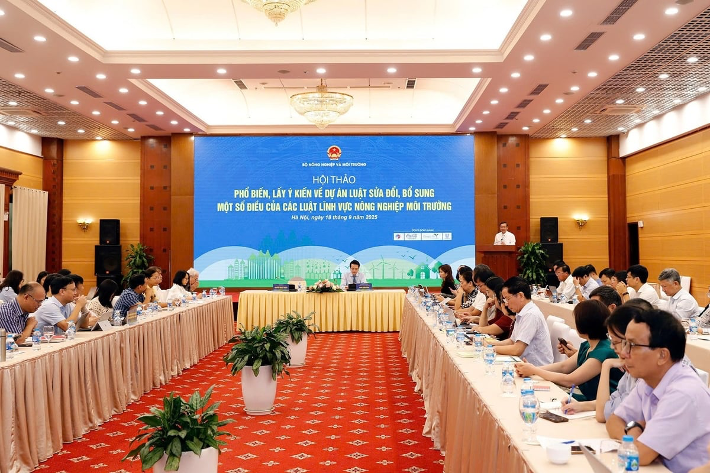
Representatives from departments, divisions, associations, businesses, and experts participated in providing feedback at the workshop. Photo: Agriculture and Environment Newspaper
The draft law includes amendments and supplements to many important contents of 15 laws such as: the Law on Environmental Protection; the Law on Plant Protection and Quarantine; the Law on Livestock; the Law on Biodiversity; the Law on Dikes; the Law on Surveying and Mapping; the Law on Meteorology and Hydrology; the Law on Forestry; the Law on Disaster Prevention and Control; the Law on Water Resources; the Law on Marine and Island Resources and Environment; the Law on Veterinary Medicine; the Law on Irrigation; and the Law on Fisheries. The Law on Crop Production. The draft law consists of 17 articles – including 15 articles amending and supplementing the 15 aforementioned laws (Land Law, Geology and Mineral Law amended separately), Article 16 on effective date and Article 17 on transitional provisions. It is expected to take effect from January 1, 2026, except for the provision on the preparation of integrated water resource and irrigation infrastructure planning for inter-provincial river basins, which will be implemented from January 1, 2027.
According to the Legal Department, the project focuses on three main groups of content. Firstly, it focuses on changing the name to implement Resolution No. 190/2025/QH15 dated February 19, 2025 of the National Assembly regulating the handling of some issues related to the reorganization of the state apparatus. The amendments aim to define the authority and responsibilities related to the two levels of local government by replacing the phrase “district level” with “commune level” or “provincial level”; or abolishing the phrase “district level”; or amending and supplementing it in cases where replacement or abolition is not possible for articles, clauses, and points in the Laws. Simultaneously, the phrases “Government,” “Prime Minister,” “Minister,” and “Minister” are changed; or the phrases “Government,” “Prime Minister,” “Minister,” and “Minister” are abolished; or amendments and supplements are made in cases where replacement or abolition is not possible for articles, clauses, and points in the Laws.
Regarding the second group, the draft Law amends and supplements 75 articles of the Laws. Specifically, it abolishes investment and business conditions in 26 articles of 8 Laws and reduces and simplifies administrative procedures in 49 articles of 9 Laws. The goal is to implement the Party and Government’s policy on reforming, reducing, and simplifying administrative procedures and investment and business conditions, creating a favorable, healthy, and fair business environment, with people and businesses at the center, and promoting innovation.
Thirdly, the focus is on immediately addressing “bottlenecks” arising from practical experience. The Ministry of Agriculture and Environment has identified 20 urgent issues that need to be resolved in 2025, focusing on 9 laws such as the Forestry Law, the Water Resources Law, the Environmental Protection Law, the Fisheries Law, the Dike Law, etc. These issues include the conversion of forest land use, regulations on forest environmental services and forest carbon, inter-provincial river basin planning, dike protection corridors, and regulations on imported scrap materials for production. Focusing on resolving the “bottlenecks” that have matured is considered a condition to ensure the effective implementation of the law, while also creating a foundation for a comprehensive review and amendment of laws in the 2026-2030 period.
According to Mr. Phan Tuan Hung, Director of the Legal Department, the draft law does not aim to address all obstacles immediately, but focuses on truly urgent and clear issues that need immediate resolution. The remaining contents will be summarized and included in the legislative program in the following years.
With its broad scope, covering many areas of management, the draft law amending and supplementing 15 laws in the fields of agriculture and environment is expected to create a transparent and synchronized legal framework, promote institutional reform, and contribute to sustainable agricultural development and environmental protection in the new period.