


 Trang chủ
According to Tien Phong Newspaper, in early August, the Center for Technology and Nature Conservation, in coordination with the Management Board of Special-Use and Protection Forests in Song Hinh, Tay Hoa, and Deo Ca, conducted an assessment of the habitat status and the presence of endangered primate species.
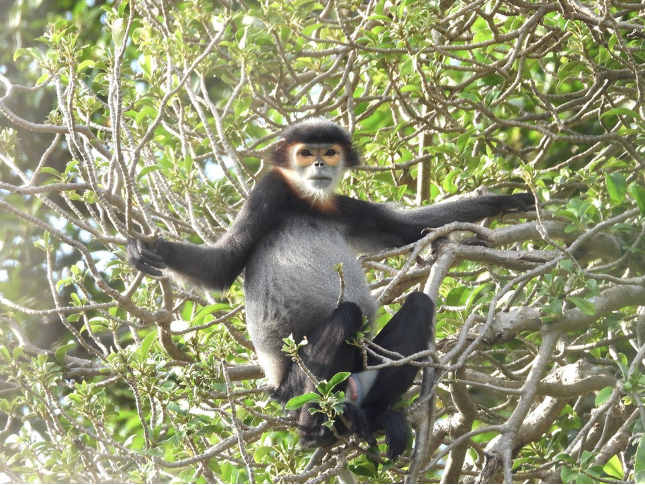
Black-footed Langur. Photo: Tien Phong Newspaper
After several days of field surveys and setting camera traps along the conservation area, the team made a remarkable discovery: a troop of more than 10 black-footed langurs (Pygathrix nigripes), including juveniles, appeared in the forest within the Dak Lak province (formerly Phu Yen province). This was surprising news, as many believed that this rare primate species had disappeared from the area due to past hunting pressure. Besides the directly observed herd, locals reported the possibility of another herd existing a few hours’ walk away, which needs to be verified in subsequent surveys.
The black-footed langur is endemic to Indochina, scattered across the South Central and Central Highlands regions, and has been recorded in Quang Ngai, Gia Lai, Khanh Hoa, and Lam Dong provinces. However, few individuals remain in the wild today. The species is listed as Critically Endangered (CR) in the IUCN Red List. The discovery of a new herd at Deo Ca Pass – a rare contiguous forest area in the South Central region – is of great significance for conservation efforts, confirming that this area remains an important habitat corridor for species with demanding ecological requirements.
The discovery of the new black-footed langur population, along with the rich biodiversity data in Dak Lak, shows that this region continues to play a key role in nature conservation. This is an important foundation for authorities to propose higher-level protection solutions, aimed at maintaining interregional biodiversity and preventing ecosystem degradation.