


 Trang chủ
In the context of Vietnam’s agriculture needing to accelerate to maintain its export position and ensure food security, gene editing technology is considered a strategic solution, opening up great opportunities for sustainable production and high productivity. However, despite possessing superior advantages over traditional gene transfer technology that only precisely affects endogenous DNA, lower costs, and shorter product creation time, gene editing technology in Vietnam has not been developed proportionally.
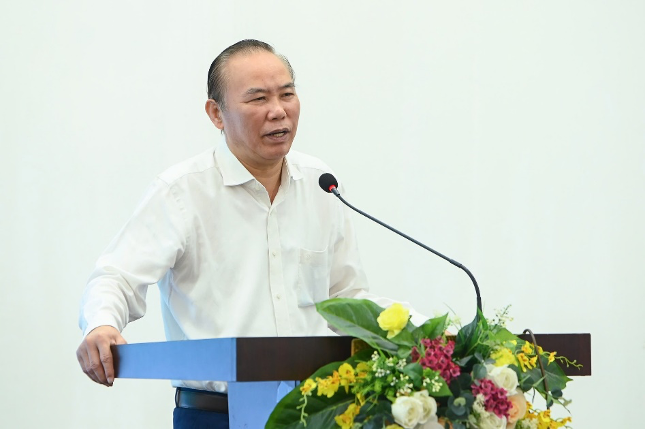
Deputy Minister of Agriculture and Environment Phung Duc Tien believes that completing the legal framework remains a prerequisite for science and technology to be effective. Photo: Agriculture and Environment Newspaper.
The core issue emphasized by many experts and managers is the incomplete legal framework. According to Deputy Minister of Agriculture and Environment Phung Duc Tien, technology can only be effective when accompanied by a complete, transparent, and advanced legal framework, creating motivation for scientists to confidently dedicate themselves to their work.
To address this bottleneck, the Ministry of Agriculture and Environment is urgently building and perfecting the legal framework, focusing on clearly defining the concepts of “gene editing” and “genetically modified organisms (GMOs).” Ms. Nguyen Thi Kim Anh, a member of the National Assembly’s Committee on Science, Technology and Environment, affirmed that it is time to institutionalize the concept of “gene editing” in the Biodiversity Law and related laws. This will serve as a basis for the Government to regulate in detail the scope and criteria for management, ensuring transparency and facilitating innovation.
The lack of a legal framework is causing many research results to be “constrained,” preventing their application and commercialization. Furthermore, the lack of technical standards for genetically modified crops is also a major obstacle. Businesses and scientists alike agree that laws and regulations must be in place first, before developing research and application systems. This would not only encourage businesses to invest boldly in R&D but also help build social trust through comprehensive scientific communication, thereby making genetic editing technology a key driving force for Vietnam’s modern agriculture.