


 Trang chủ
The Cat Ba Archipelago (Hai Phong) has been re-inscribed by UNESCO on the list of World Biosphere Reserves after its 10-year periodic assessment (2014-2024). This decision was announced at the 37th session of the International Coordinating Council of the Man and Biosphere Programme (MAB ICC) on September 27th, marking a new affirmation of long-term efforts in nature conservation linked to socio-economic development in Vietnam.
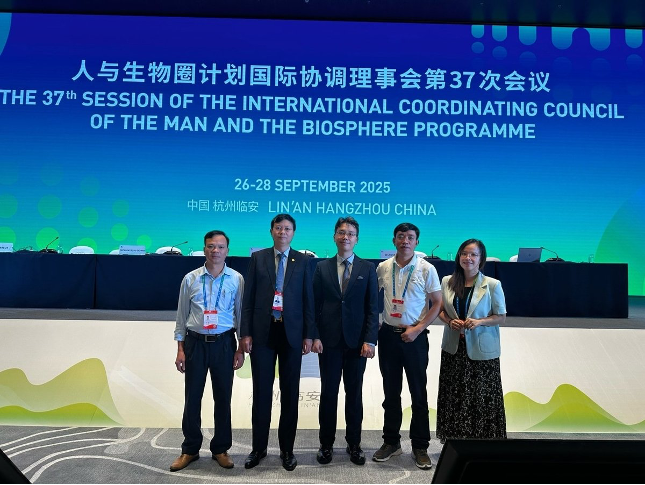 Representatives of the Vietnam National UNESCO Committee, MAB Vietnam, and the Cat Ba Biosphere Reserve Management Board at the Conference. Photo: Agriculture and Environment Newspaper
According to UNESCO, management in Cat Ba is implemented comprehensively, mobilizing the participation of many stakeholders from the government to the community. This model is considered a useful experience for other biosphere reserves in the Northwest Pacific region. Notably, Cat Ba is the only place in the world where the rare Cat Ba langur still lives. After more than two decades of implementing conservation projects led by Cat Ba National Park, the langur population has increased from approximately 40 individuals in 2000 to 76 individuals in 2023, demonstrating the clear success of long-term conservation measures.
Alongside conservation, the locality has promoted economic development programs linked to ecology. Sustainable tourism activities, services bearing the biosphere label, and community development funds have helped improve the livelihoods of the people and encouraged their direct participation in resource protection. This renewed UNESCO recognition shows that Cat Ba has fully met the stringent criteria of the global biosphere reserve.
Beyond its rich biological value, Cat Ba also possesses karst geological features eroded by the sea and preserves historical evidence of ancient Vietnamese habitation. With the recognition of Ha Long Bay – Cat Ba Archipelago as a World Natural Heritage Site in 2023, this archipelago continues to affirm its special position on the international heritage map. With these achievements, Cat Ba is expected to maintain its role as a “living laboratory” for humanity in biodiversity conservation, resource management, and green economic development, making a positive contribution to global sustainable development goals.