


 Trang chủ
The Decree is expected to enhance conservation capacity while opening opportunities for the development of the bioeconomy and circular economy, thereby contributing to sustainable development.
On the afternoon of 9 May, Minister of Agriculture and Environment Do Duc Duy, together with Deputy Minister Nguyen Quoc Tri, chaired a meeting to hear a report on the draft Decree on the management of endangered, precious and rare species and the implementation of the Convention on International Trade in Endangered Species of Wild Fauna and Flora (CITES).
Speaking at the meeting, Minister Do Duc Duy stated that the development of a new Decree integrating regulations related to endangered, precious and rare species is expected to create a breakthrough in nature conservation while also contributing to the promotion of green economic development.
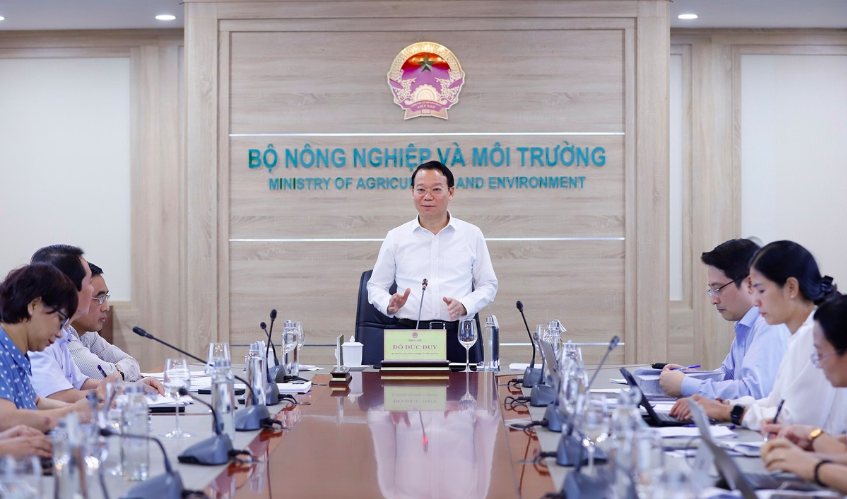
Minister Do Duc Duy listened to the report on the draft Decree on the management of endangered, precious and rare species and the implementation of the Convention on International Trade in Endangered Species of Wild Fauna and Flora (CITES). Photo: Khuong Trung.
With the spirit of clarity, transparency, and simplification of administrative procedures, the Decree will not only facilitate organizations and individuals but also help state agencies improve the effectiveness of management, inspection, and supervision.
Reasonable integration and proper exclusion
During the discussions on the development of the Decree, participants agreed on integrating regulations that were previously scattered in two different laws: one governing “endangered, precious and rare species,” and the other governing “endangered, precious and rare species prioritized for protection.”
Minister Do Duc Duy emphasized that, in essence, these belong to the same group of subjects. However, due to different regulatory approaches, overlaps and inconsistencies previously existed. The integration is therefore considered necessary, reasonable, and a step in the right direction.
However, to avoid conflicts with other specialized laws such as the Law on Fisheries, the Law on Crop Production, and the Law on Plant Protection and Quarantine—areas that already have clear regulations—the Decree needs to clearly define its scope of regulation.
At the same time, provisions should be added to exclude species already governed by these specialized laws, thereby preventing legal conflicts and increasing transparency in implementation.
One process, one authority, one set of documents
Regarding management principles, an important recommendation is that if the same subject and management objective are involved, there should be only one unified process in terms of content and the responsible authority. For example, endangered, precious and rare species and those prioritized for protection are essentially the same group; therefore, there should be one set of documents, one process, and one competent authority responsible for licensing.
Minister Do Duc Duy also stressed that development should go hand in hand with conservation. Many species, although rare and precious, can still be incorporated into economic activities and commercialized appropriately if successful breeding programs increase their populations. For instance, if a species previously had only 200 individuals but has been successfully bred to reach 500 individuals, allowing partial exploitation and commercialization would not harm conservation efforts. Instead, it could enhance economic value and create long-term incentives for protection.
Previously, wildlife resources in Vinh Long were very diverse and abundant; however, due to various impacts, many species have gradually disappeared. Photo: Minh Dam.
This technical principle should be clearly reflected in the Decree to ensure scientific validity, practical relevance, and feasibility in implementation.
Flexible decentralization: assigning the right authority to the right level
Regarding decentralization and delegation of authority, the guiding principle is to enhance initiative and flexibility at different administrative levels. Accordingly, the Government may delegate authority to the Minister, and the Minister may further delegate authority to Chairpersons of provincial and local People’s Committees.
In particular, the issuance of species lists should be delegated to the Minister, as new species may emerge or be introduced through international cooperation. This approach is considered more appropriate than having the Government or the Prime Minister issue such lists as previously practiced.
In terms of implementation, local authorities should be entrusted with specific responsibilities in protecting and managing endangered, precious and rare species. In reality, many localities already have sufficient capacity to effectively carry out these tasks when given clear authority.
Reforming procedures and reducing costs and time
In line with the spirit of Resolution 66, the Decree should concretize key reform targets: reducing administrative procedures by 30%, shortening processing time by 30%, and cutting compliance costs by 30%. These reforms should not remain theoretical but must be demonstrated through clear comparison tables showing the old and new procedures, responsible authorities, processing time, and associated costs.
For example, if a procedure previously handled by the Ministry required 30 days, delegating the authority to local governments could reduce the processing time to only 20 days. Transparency and measurability are essential conditions for substantive reform.
Minister Do Duc Duy emphasized that once issued, the Decree will help strengthen conservation capacity while also opening opportunities for the development of the bioeconomy and circular economy, which are key pillars of the country’s sustainable development strategy.
When effectively implemented, the Decree will not only represent a legal step forward but also reflect a modern, practical governance approach that places people and businesses at the center of development.