


 Trang chủ
A team of botanists from the Institute of Life Sciences, the Central Vietnam Institute of Scientific Research, along with staff from the Cam Lo – Dong Ha inter-district forest protection unit and the Kagoshima University Museum (Japan), have discovered and described a new species of the genus Lasianthus, with samples collected from Quang Tri and Quang Binh provinces.
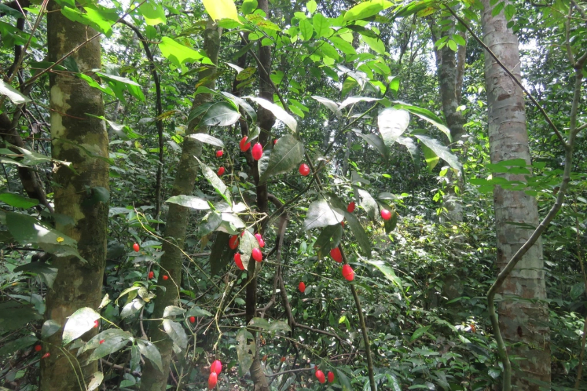
The newly announced Lasianthus species was discovered in the Ru Linh primary forest – Photo: Dan Tri Newspaper
The genus Lasianthus is a large genus in the Rubiaceae family, with 292 species distributed widely throughout the world. Previously, Vietnam had recorded 74 species belonging to this genus. The species Lasianthus trongii V.S.Dang, T.A.Le & Tagane is named after Mr. Nguyen Dinh Trong, who has contributed to protecting the Ru Linh forest for over 40 years, the area where the species was first discovered and samples were collected.
Lasianthus trongii is a shrub 1-3 m tall, with hairless stems, opposite leaves, elliptical or lanceolate blades, hairless on both sides, pointed apex, nearly rounded base, entire margin, 6-8 pairs of secondary veins, hairless petioles 2-3 mm long, and small, triangular stipules. The inflorescence is a cyme with 7 flowers, nearly sessile, white, bell-shaped to truncated cone calyx, hairless, divided into 4 triangular lobes. There are 4 stamens attached to the corolla tube, the ovary has 4 chambers, the style is 1.5-2 mm long, hairy, and has 3 lobes. The drupe is egg-shaped to spherical, smooth, and a striking orange-red color when ripe, making it easily distinguishable in nature. Lasianthus trongii is morphologically similar to L. tamdaoensis and L. kailarsenii. However, the species is clearly distinguished by the morphology of its leaves, flowers, and fruits, the most prominent feature being the orange-red color of the fruit, which is completely different from the blue fruit of the other two species. Although this species is found in both Quang Binh and Quang Tri, the number of individuals is very small, so scientists propose classifying the species as endangered.