


 Trang chủ
On January 9th, information from Phong Nha-Ke Bang National Park, Quang Binh province, indicated that a research team from the Vietnam Museum of Nature had discovered a new species of terrestrial snail in Son Doong Cave. This is the first recorded example of a terrestrial gastropod mollusk in Vietnam.
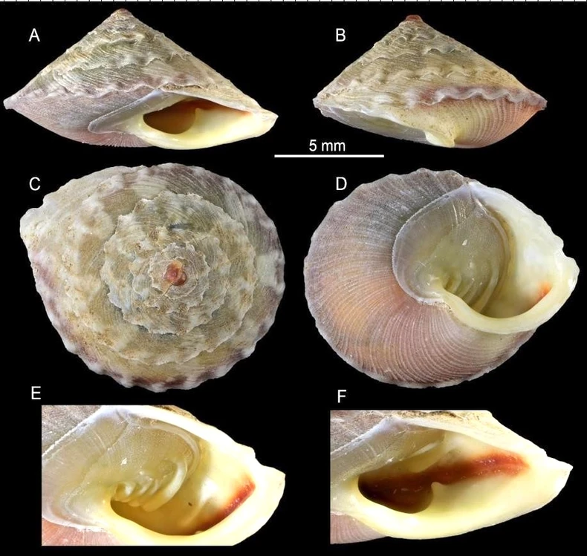
A new species of land snail was photographed in a laboratory. (Photo: Phong Nha-Ke Bang National Park)
The new snail species has been given the scientific name Calybium plicatus Hoang et al., 2025, based on the characteristic ridges appearing on the apical edge inside the shell mouth (from the Latin: plicatus meaning ridge, fold). The specimen was discovered at Sinkhole 1 in Son Doong Cave, Phong Nha-Ke Bang National Park, Quang Binh province.
This is the second species of the genus Calybium Morlet, 1892 (Gastropoda: Helicinidae) discovered in the world and the first recorded for the Vietnamese fauna. Calybium plicatus sp.nov. has a shell shape similar to Calybium massiei, Morlet, 1892, but differs in having a smaller shell size and apical wall with six evenly spaced plates.
Phong Nha – Ke Bang National Park currently records 2,954 species of vascular plants, belonging to 1,007 genera, 198 families, 63 orders, 12 classes, and 6 phyla. Of these, 111 species are listed in the Vietnam Red Book, 121 species are listed in the IUCN Red Book, and 3 species are named in Government Decree No. 64/2019/ND-CP dated July 16, 2019.
Regarding animals, 1,399 species belonging to 835 genera, 289 families, 66 orders, 12 classes, and 4 phyla have been recorded. Of these, 82 species are listed in the Vietnam Red Book, 116 in the IUCN Red Book, 39 in Decree No. 64/2019/ND-CP, and 66 in the CITES appendices.
The new species was published in the Ruthenica, Russian Malacological Journal, in January 2025. The discovery of this new land snail species further confirms that Vietnam is a country with high biodiversity in the world, especially in its limestone mountain and cave forest ecosystems.