


 Trang chủ
According to the Agriculture and Environment Newspaper, on July 2nd, representatives from the Wildlife Rescue Department – a unit under the Dak Lak Elephant Conservation, Animal Rescue and Forest Management Center (located in Buon Don commune, Dak Lak province) – announced that from mid-June to the present, the unit has released 12 rare wild animals back into the wild in the forest area of Chu Yang Sin National Park.
Among the released individuals are many species that require strict protection, such as: Javan pangolin, pig-tailed macaque, long-tailed macaque, giant tortoise, sand turtle, clouded monitor lizard, and civet.
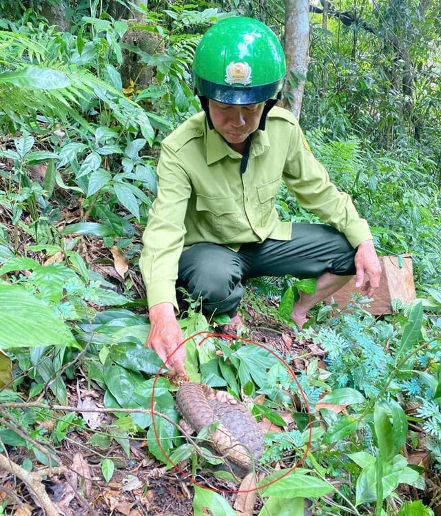 Before being released back into the Chu Yang Sin National Park, the Javan pangolins were received, cared for, and thoroughly checked for health by the Center. Photo: Agriculture and Environment Newspaper
Most of the rare animal species released back into the Central Highlands forests have adapted well, are agile, and quickly mastered the skill of foraging for food in the wild.
Among the species released back into the forest is the Javan pangolin – an endangered and rare animal listed in the World Red List, whose exploitation, use, and trade are absolutely prohibited by Vietnamese law.
In addition, the pig-tailed macaque – a species belonging to Group IIB according to current regulations – has also been released back into the forest. This species is threatened and currently lives mainly in natural forests in Central Vietnam, the Central Highlands, and the Northwest. All hunting, transporting, or trading is strictly prohibited.
Rare turtle species such as the giant tortoise (Cuora mouhotii) are also on the list of those released back into the forest. The giant tortoise currently has a very small population in the wild, usually distributed in localities such as Dak Lak, Gia Lai, and Dong Nai. The sand turtle is classified as Group IIB, distributed in Lao Cai, Thanh Hoa, Nghe An, and Dak Lak provinces.
The civet – a species facing extinction due to a severe decline in its wild population – was also released back into its natural habitat in this release.
Mr. Le Van Hong, Head of the Wildlife Rescue Department ( thuộc the Dak Lak Elephant Conservation, Animal Rescue and Forest Management Center), said that before being released back into the wild, all these rare individuals were received, nurtured, and rigorously health-checked by the Center. Therefore, upon returning to the forest environment, they quickly adapted and survived effectively.