


 Trang chủ
According to the Agriculture and Environment Newspaper, on September 16th, the United Nations Development Programme (UNDP) Vietnam held a summary meeting for the Biodiversity Network and Ecosystem Services (BES-Net) project, phase 2022-2025. The project, funded by the German Ministry of Environment, Nature Conservation, Nuclear Safety and Consumer Protection and SwedBio, aims to restore ecosystems and encourage community participation in conservation in key areas.
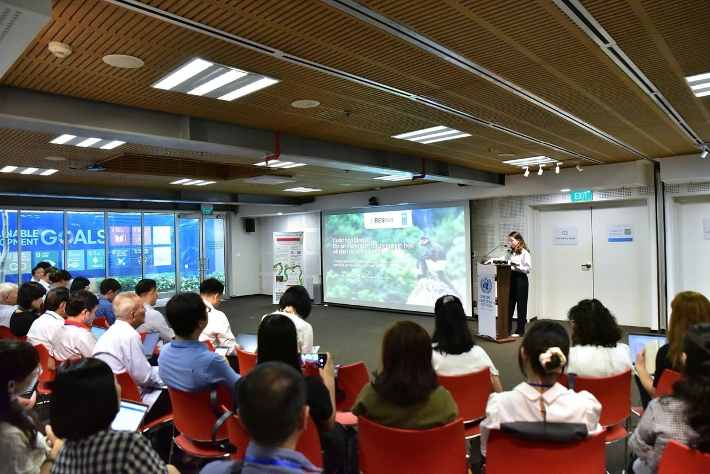
Summary meeting of BES-Net phase 2 project implemented by UNDP Vietnam. Photo: Agriculture and Environment Newspaper
The project benefited over 800 people, restored over 110 hectares of wetlands, and created new impetus for conservation-related livelihood models in Tram Chim National Park and Van Long Nature Reserve. At Tram Chim, the project supports the restoration of the wild rice and sedge ecosystem – the main food source for the red-crowned crane. Thanks to water level regulation and intervention measures, the ecosystem has improved significantly: many bird species have returned, including four red-crowned cranes that reappeared after a two-year absence. Simultaneously, flood-adaptive livelihood models are being promoted. UNDP supports the Dong Thap community in developing a rice-fish farming model, utilizing the flood season to raise natural aquatic life, helping to increase income and reduce overfishing. Thanks to the consensus of the people, this approach is both economically effective and contributes to maintaining ecological resources.
At Van Long, the project collaborates with the Wildlife Conservation Organization (SVW) to protect the habitat of over 300 white-buttocked langurs and hundreds of bird species, while also raising community awareness about sustainable ecotourism. UNDP emphasizes that conservation is only sustainable with the active participation of the people. A new aspect of BES-Net is the testing of a payment mechanism for wetland ecosystem services at Tram Chim, focusing on aquaculture and ecotourism. This is considered a crucial step in developing a policy for paying for ecosystem services, similar to the mechanism successfully applied to forests.
The results of BES-Net are expected to contribute to the realization of the National Strategy on Biodiversity to 2030, with a vision to 2050, and to replicate community-participated conservation models nationwide.