


 Trang chủ
Recently, the Institute of Ecology and Biological Resources (Vietnam Academy of Science and Technology), in collaboration with the Center for Informatics and Computing, Natural Science and Technology Publishing House, successfully updated the Red List database and compiled the Vietnamese Red Book within the framework of the project: “Updating the Red List Database and Compiling the Vietnamese Red Book”.
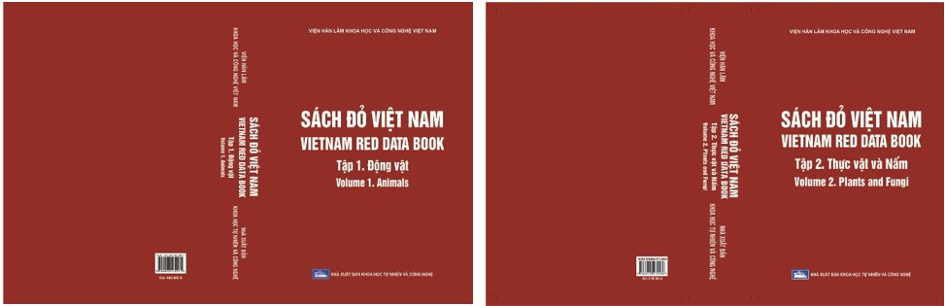
Cover of the two volumes of the Vietnam Red Book: Volume 1. Animals and Volume 2. Plants and Fungi.
The Red List and the Vietnamese Red Book are important documents in the work of protecting biological resources and implementing international conventions to which Vietnam is a party, such as the Convention on Biological Diversity (CBD) and the Convention on International Trade in Endangered Species of Wild Animals and Plants (CITES). This information also serves as the basis for developing legal documents and policies, such as decrees and national strategies related to the protection and sustainable development of rare and endangered wild animal and plant species.
A unique aspect of this project is the development of the Vietnam Red List on an online platform, allowing users to search for detailed information on 1,398 species facing extinction in Vietnam. This system is designed similarly to the IUCN Red List, organized according to a scientific classification system and supporting online information retrieval. The Vietnam Red Book has also been compiled and published, including Volume 1 on animals (742 species) and Volume 2 on plants and fungi (656 species). Expert groups have updated, supplemented, and adjusted the conservation classification for 1,398 species. Each species in the list provides complete information on its scientific name, identifying characteristics, distribution, population status, biological characteristics, threats, and necessary conservation measures.
According to the project leader, Prof. Dr. Nguyen Quang Truong: Updated information in the Red List and the Red Book of Vietnam has made a significant contribution to the assessment and supplementation of records for species being added to or removed from the list of endangered, rare, and precious species issued with government decrees. This is also a useful reference document not only for management agencies in the field of biological resources but also valuable for research and training.