


 Trang chủ
According to the Agriculture and Environment Newspaper, from September 22 to 27 in Hangzhou (China), the 5th World Biosphere Reserve Conference and the 37th Session of the International Coordinating Council of the Man and Biosphere Programme (MAB ICC) were held, bringing together more than 4,000 delegates from 136 countries. This is the world’s largest event on conservation and sustainable development within the framework of UNESCO’s MAB Programme, held every 10 years.
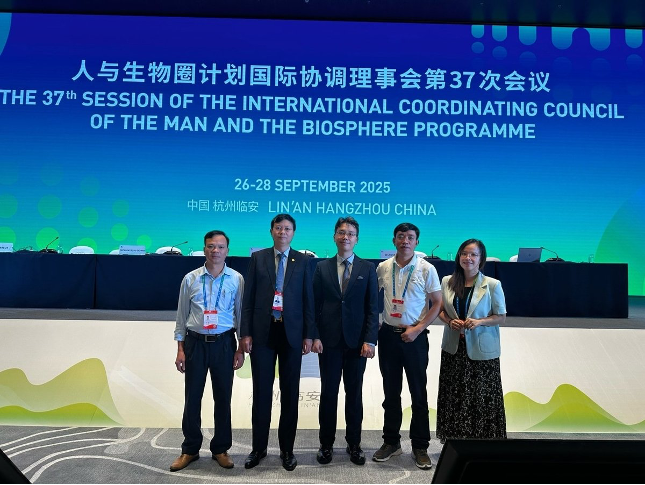
The Vietnamese delegation attended the 5th World Biosphere Reserve Conference from September 22-25, 2025 in Hangzhou, China. Photo: Provided by the delegation. Source: Agriculture and Environment Newspaper
The discussions focused on the role of biosphere reserve networks in protecting biodiversity, responding to climate change, and building models of harmonious development between humans and nature. Two important documents were adopted: the Hangzhou Strategic Action Plan 2026-2035 and the Hangzhou Declaration, affirming the global commitment towards sustainable development. Vietnam participated in the conference with a delegation including representatives from the Vietnam National UNESCO Committee, the Vietnam National Committee for the Man and Biosphere Program, and many Biosphere Reserve Management Boards.
After 25 years since the Can Gio Biosphere Reserve was recognized (2000), Vietnam now has 11 Biosphere Reserves, ranking second in Southeast Asia after Indonesia. These reserves occupy approximately 14% of the territory, both conserving biodiversity and providing impetus for green economic development, enhancing climate change adaptation capacity and reducing carbon emissions. Models in Vietnam are impressive due to the active participation of communities, especially ethnic minorities in mountainous areas, as well as the strong links with universities, research institutes, and businesses. Many Biosphere Reserves have developed distinctive products, creating sustainable livelihoods while promoting natural and cultural values to the world.
In the coming period, MAB Vietnam has identified five core values: sustainability, community, connectivity, innovation, and adaptation. These are considered the guiding principles that will help Vietnam’s Biosphere Reserve network continue to play a pioneering role, becoming a typical green development model, contributing to global conservation and sustainable development goals.